
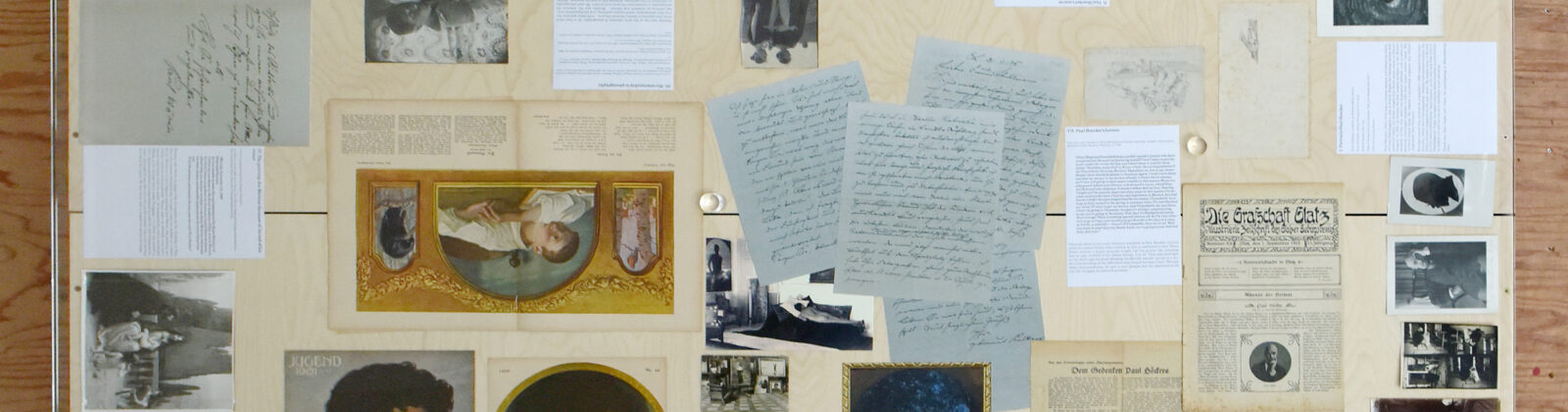
Christina Spachtholz
Dear Paul,
Throughout our years of research into your life and work, I’ve read numerous letters from you. And I have written quite a few texts about you. This time, rather than producing another scholarly work, I feel compelled to write you a personal letter.
I’m truly grateful to have encountered you. When I wrote my first thesis about you at university, it saddened me to realize that it was merely intended for a grade, to be read by my professor and then forgotten again. But you deserve to be remembered. What a happy coincidence that I joined up with others who share this conviction at Forum Queeres Archiv München (FQAM).
I will remember you for the person you were, not just as the teacher, mentioned briefly in your students’ biographies.
I will remember you as the kindhearted mentor, who encouraged them to explore and find themselves, whilst being unable to express his own identity.
I will remember you as a wonderful painter, who captured the beauty and emotion of your portrayed models in such a sensitive way.
The still melancholy in your earlier works speaks to me just as much as your liberated portrayal of male beauties in your later work. In every piece, I see you. The diversity within your oeuvre vividly captures the vast range of emotions you experience. Each work depicting meditative nuns and monks, reveals a piece of your inner world. These figures, embodying the solitude and discipline of a life devoted to reflection and strict adherence to rules, mirror the complex facets of your emotional journey—particularly the bittersweet peace of concealing your true self. I can see your desire in the paintings of beautiful men, covering their bodies in innocent and whimsical pierrot costumes, masking the loving detail you would designate for their physique. Yet, their eyes reveal the depth of your affection and intent.
You were more than an artist, more than a teacher—you were a person of deep emotion, of complex identity, who navigated the world with a grace that belied the challenges you faced. Your legacy, though nearly lost to time, has found its way back into the world, and with it, a recognition of the love and passion that you poured into your art. I want you to know that your story is being told, not just as a cautionary tale of a society that failed to understand you, but as a celebration of your life, your courage, and your undeniable talent.
In remembering you, I see not just the person you were, but the one you could have been, had the world been different. And in that remembrance, I find both sorrow and joy—sorrow for the struggles you endured, and joy that your art continues to speak to us, to move us, and to remind us of the beauty of being true to oneself.
With deep affection,
Christina
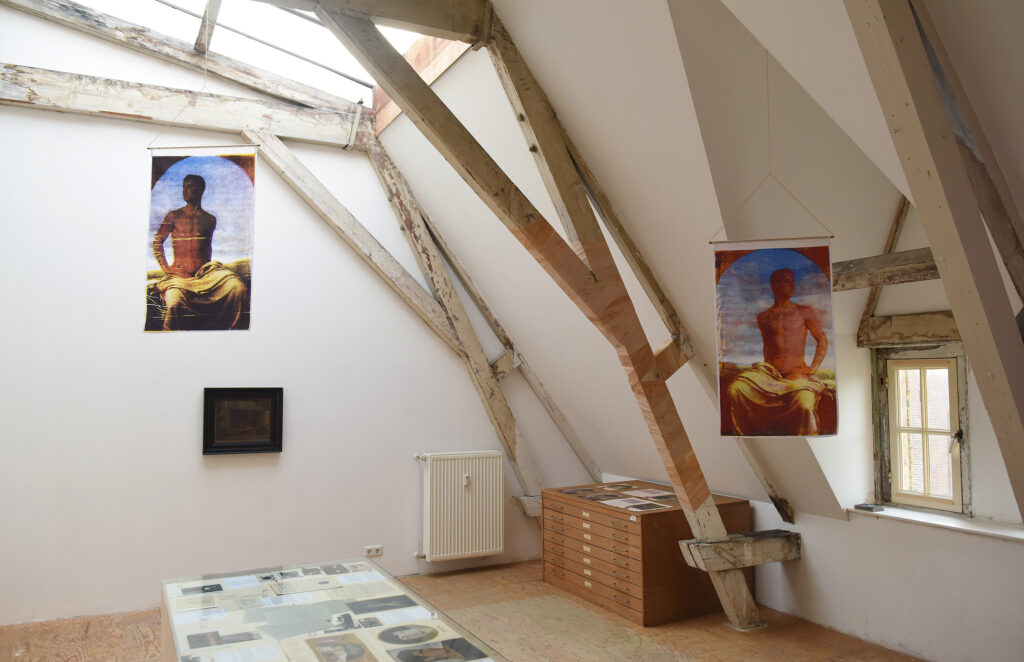
Philipp Gufler
The artist Paul Hoecker was born in 1854 in Oberlangenau in Schlesien, now the Polish town of Długopole Górne. From 1871, the year Paul celebrated his seventeenth birthday, Paragraph 175 criminalized samesex love between men in Germany. After his studies at the Academy of Fine Arts in Munich Paul Hoecker lived for a while in Berlin, where he met the physician and sexologist Magnus Hirschfeld. With the co-founding of the Scientific-Humanitarian Committee in 1897, Magnus Hirschfeld was one of the most prominent advocates of the homosexual movement at the turn of the century, calling for the abolition of Paragraph 175. In his biography, Hirschfeld writes how Hoecker was only able to come to terms with his own homosexuality after recognizing the queer identity of artists such as Leonardo da Vinci or Michelangelo Buonarotti:
Many years ago, one of the most admired painters of that time once told me that he had only been able to reconcile himself with his own lot as an Urning when he learned that the four Renaissance painters he revered most had been his companions in destiny. […] When he recognized these four immortals as ‘such,’ his melancholy turned into humility, his grief into pride.1
Paragraph 175 was not abolished during the Weimar Republic, when for the first time a more visible queer movement was possible. Paragraph 175 was tightened during the Nazi dictatorship and bars, magazines and organizations like Magnus Hirschfeld’s Institute for Sexual Research—which could be considered the first queer archive and museum in history—were banned and destroyed. In West Germany, the paragraph continued to be applied after 1945 in the form introduced by the Nazis. It was no longer applied after 1969, but was only removed completely from law without replacement after the reunification. A remembrance of the first queer movement before the Nazi regime in Germany was therefore only possible from the 1970s onwards, when various queer activist communities and grassroots archives were formed.
The effects of the suppression of queer history through persecution and social exclusion right up to the present day are also shown by the reception of Paul Hoecker, who has been excluded from art history. Despite his participation in exhibitions like the first to third Venice Biennale and the Chicago’s World Fair in 1893 among many others, and his influence as the first modern professor at the Academy of Fine Arts in Munich, his works and biography are almost forgotten today. At the grassroots archive Forum Queeres Archiv München (FQAM), Stefan Gruhne, Nicholas Maniu, Christina Spachtholz and myself are researching his artistic oeuvre, his exchange with the homosexual emancipation movement around Magnus Hirschfeld and his life in Italy after he had to leave the Academy.
When I moved to Munich to study at the Academy of Fine Arts in 2008, 110 years after his dismissal, I was disappointed how heteronormative and sexist many of the students and the almost exclusively male professors were. Maybe that’s why I was looking for a queer past, to imagine a more queer present and future at the institution, the art scene in Munich and myself? Through the exhibition catalog “Goodbye to Berlin? 100 Jahre Schwulenbewegung” from 1997 I heard about Hoecker for the first time and started to look for more traces of his life. I could only find a few more articles and images online. After finding his letter of termination from the Academy on October 11, 1898, I dedicated one of my quilts—my ongoing series of silkscreen prints on fabric in memory of artists, writers, magazines and lost queer spaces—to Paul Hoecker in 2018 and used quotes from his letter of termination.
When our research group learned more about the work and life of Paul Hoecker, I may have felt similarly to how he felt when discovering the queer identity of some Renaissance artists. Of course the political and social situation in Germany has changed fundamentally since Paragraph 175 was abolished without replacement in 1994. With every new work and every new letter we found from him, I was able to better understand his artistic and human development despite the setbacks he experienced. The past is never a closed subject. We have to take care of the people in the past too.

Nicholas Maniu
Although I studied art history in Munich, I never came across the name Paul Hoecker until I became involved in the FQAM and would later also join the research group trying to reawaken interest in an unjustly forgotten queer artist. With my own art historical research focusing on queer studies, iconography/ iconology and visual culture studies, I am aware of the importance of visibility and how we as queer people have to fight to be represented in historiography. Remembering Paul is a crucial part in this process, especially in light of recent attacks on queer visibility.
In my dissertation Queere Männlichkeiten. Bilderwelten männlich-männlichen Begehrens und queerer Geschlechtlichkeit (2023) I have tried to showcase the complex history of queer masculinities within different cultures and societies that have long considered them to be a ‘sin’ or a ‘sickness’, and how those ideas linger on like a palimpsest and haunt us today.2 Growing up in an environment where non-heteronormative sexualities and gender identities are usually depicted as something negative—be it as some sort of ‘queer monster’ like the figures of the sodomites in a religious context or as someone with a contagious disease in a ‘scientific’ context—developing a positive (self-)image is a difficult task. Over time, two possible strategies have emerged: One can either appropriate images of the general culture and give them a new (queer) meaning, as gay men did, for example, by claiming St. Sebastian as a homoerotic icon. But one can also try to uncover the queer history that has always been there but has been buried—mythological and historical figures such as Ganymede, Hadrian and Antinoos, Il Sodoma and Michelangelo are evidence that there is a queer past. As Philipp Gufler points out in his text, Hoecker also looked to the past and was able to create a more positive (self-)image by discovering the existence of other queer artists before him such as Michelangelo.
When looking at Hoecker’s art, it is interesting to see how this new queer self-awareness emerges: While most of his earlier works are characterized by the absence and/or suppression of any eroticism—Dutch genre scenes as well as nuns and monks are the main motifs—the first glimpses of his queer desire surface in some of his recurring Pierrot portrayals.3 However, as Christina Spachtholz also emphasizes, the oversized white robes typical of the Pierrot figure hide the bodies of the handsome models he used from the viewer’s (and painter’s) gaze and turn them into sexless, almost ethereal beings. And yet, despite his efforts not to overtly express his queer desires in his paintings, it was ultimately his art that ‘revealed’ his homosexuality: It was said that Hoecker had used a male sex worker as a model for the Madonna in his religious painting Ave Maria (ca. 1897/98), with whom he allegedly also had sexual relations. The truth of these rumors could never be confirmed, but given Hoecker’s swift reaction—he resigned from his professorship at the Academy—it seems plausible. Depicting a man in drag as the Virgin Mary would definitely be an interesting albeit veiled act of queer rebellion. It would also connect back to a queer past, as the almost certainly bisexual Caravaggio was also known to use models ‘from the street’ (including sex workers) for his religious paintings.
After leaving the Academy, Hoecker went traveling and spent a lot of time in Italy. The works created from this time onwards are captivating in their undeniable homoeroticism: once veiled bodies are presented openly and lustfully (e. g. Nino, ca. 1908). Nevertheless, this liberation was accompanied by the end of his career. Hoecker was never to regain a foothold in the art world.
Learning about this equally sad and astonishing story and realizing how Hoecker was banished from history has led me to contribute to the goals of the research group. We are currently working to reintroduce Hoecker’s work into the Munich museum landscape—a possible purchase for the Lenbachhaus is in the works. If queer history teaches us anything, it is that we must fight to be included and that we must not leave the writing of history to those who have the most power—for the sake of Paul Hoecker and for all the others who have been discarded because they do not fit into dominant ideas of gender, sexuality, class and/or origin that are considered acceptable.
- Magnus Hirschfeld: Memoir. Celebrating 25 Years of the First LGBT Organization (1897–1923). Translation of Von Einst bis Jetzt by Michael A. Lombardi-Nash (1923; Jacksonville, FL: Urania Manuscripts, 2019), pp. 140-141. ↩︎
- Although ‘queer’ is an ahistorical term, I use it here as a condensed antonym for everything that lies beyond the strict male-female binarism and the idea of ‘heteronormativity’. ↩︎
- A male figure from French theater that was based on a character from the Italian Commedia dell’arte. ↩︎